When you think about the wealthiest 20% of Canadians, what comes to mind? Big houses? Luxury vehicles? Expensive vacations?
But what if I told you that the more interesting question isn't what wealthy Canadians spend their money on? It's what they actually own.
Because there's a big difference between looking wealthy and having a high net worth.
There’s a Canadian financial influencer that I follow and his name is Jim Choung .
He posted a reel the other day talking about people's primary residence and looking at the net worth of Americans and where their money is allocated.
Today I want to look at where the top 20% of Canadians and see where most of their wealth is allocated.
This is something I wanted to look into as someone like myself who’s trying to reach financial independence and seeing what I can learn.
The Wealth Gap Increasing
I think we have all heard that the rich is just getting richer.
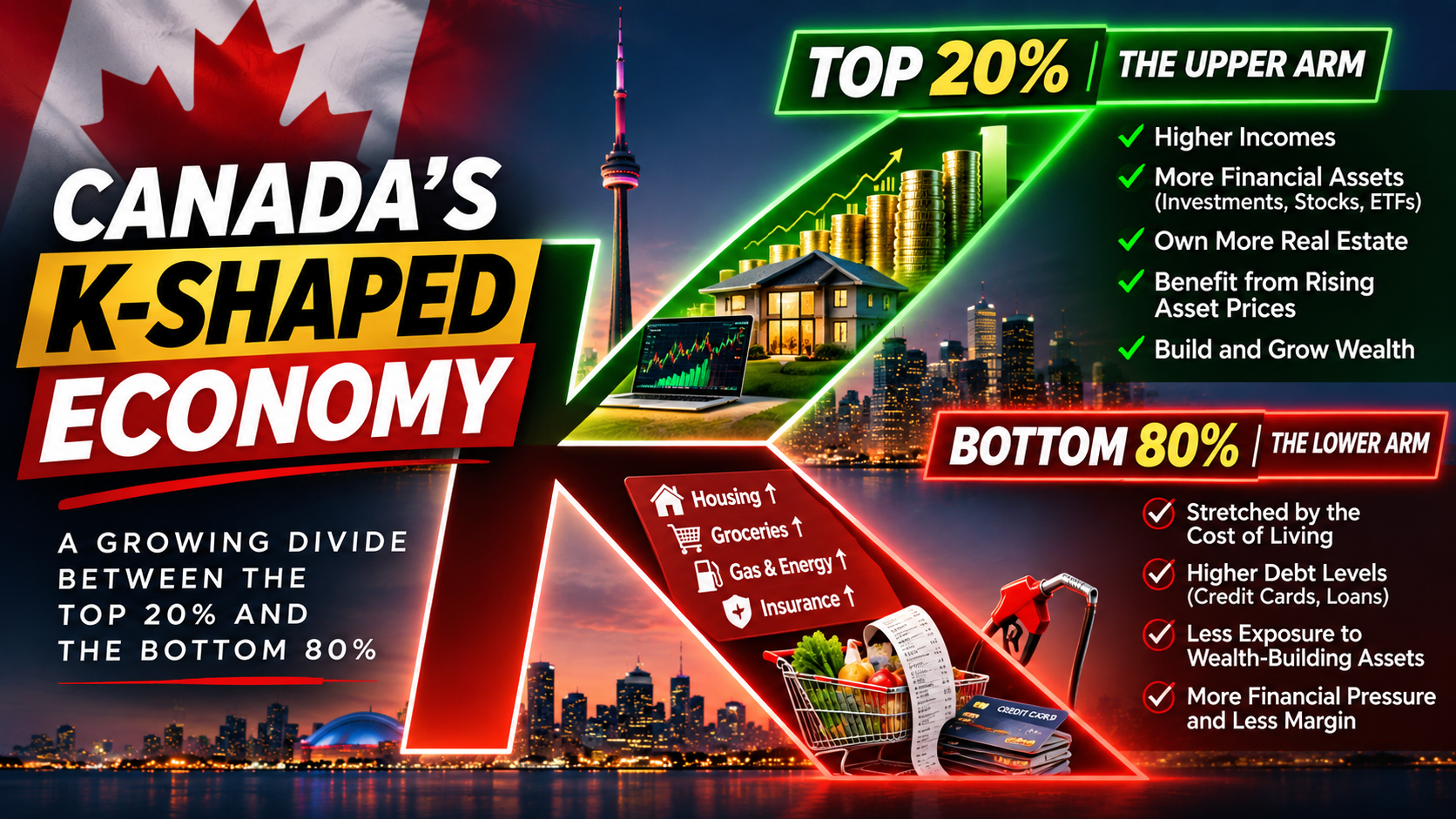
In my opinion, I believe that we are living in a K shaped economy.
This is just where different parts of society are moving in opposite directions.
On one hand, the high earners and assets owners thrive on the upper arm while the lower and middle class struggle with rising costs and debt on the lower arm.
I found a very interesting article on stats Canada that was published in April of 2026.
It talks about the: Distributions of household economic accounts for income, consumption, saving and wealth of Canadian households, fourth quarter 2025
Link to the article: https://www150.statcan.gc.ca/n1/daily-quotidien/260413/dq260413a-eng.htm
They was a part of this article that really stood out to me.
The heading for the section I’m talking about says: Wealth gap increases as wealthiest benefit most from strong equity market gains.
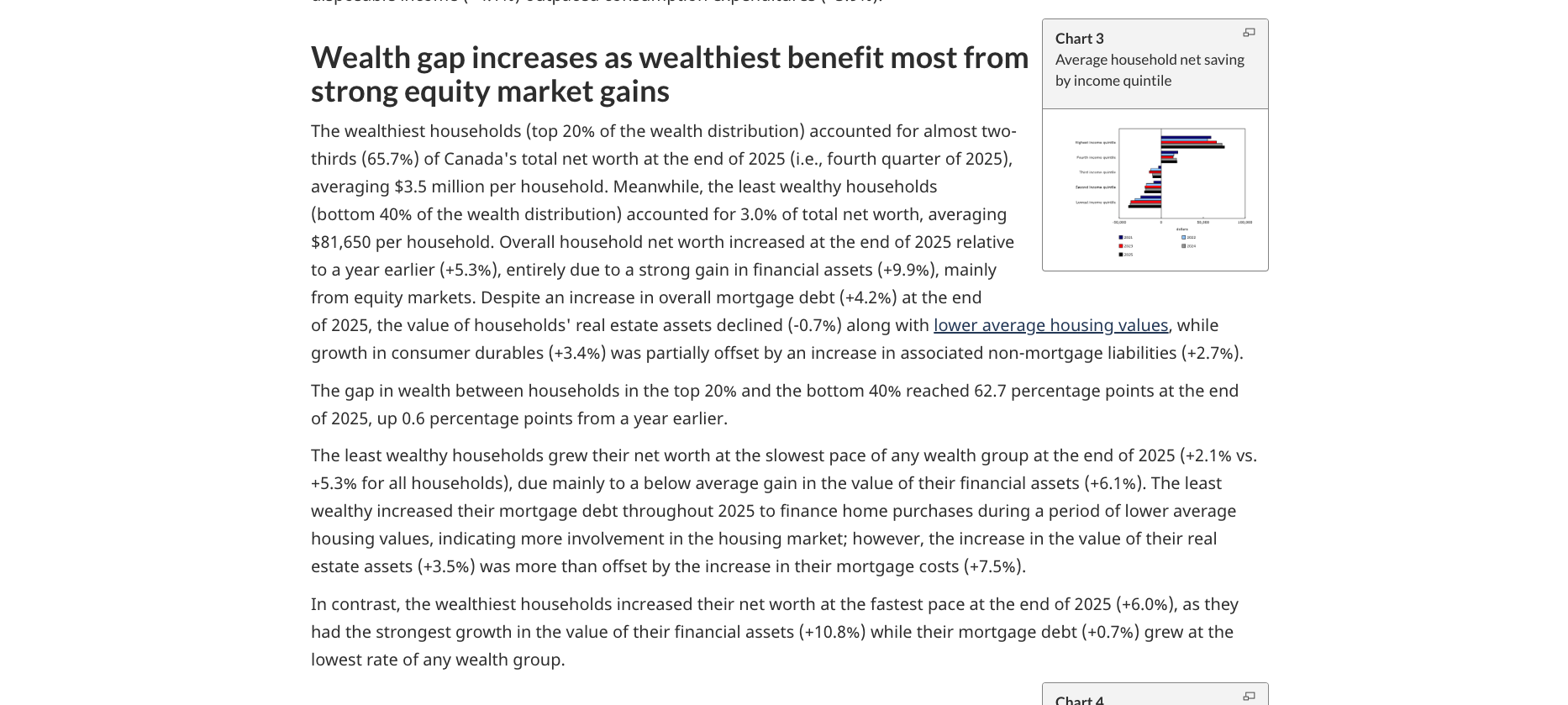
The main take away from this is the lower income households have there mortgage costs double then they value of their real estate assets - most likely their primary residence.
On the other hand, the wealthiest households, the top 20%, increased at a faster pace, by having strong growth in their financial assets by (10+%) while their mortgage debt only grew by 0.7%.
The top 20% of Canadians hold about 66% of the countries total net wealth.
The average net worth of the top 20% being around 3.5 million per house hold.
Where The Top 20% Hold Most Of Their Wealth
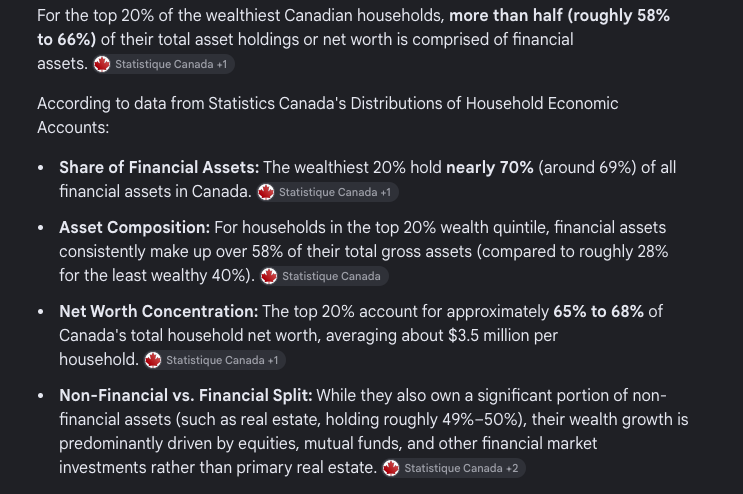
According to stats Canada, the top 20% hold close to 70% of their net worth in financial assets.
The middle 40% have about 26-27% in financial assets while the bottom 40% only have about 4%.
This really tells a story here.
Its just shows that the top 20% have most of their net worth in the financial assets that have just grown substantially.
If just look at the vanguard s&p 500 etf, in the last 5 years up 80%.
Look at nasdaq ETF and it’s up 65%.
Canadian TSX etf up 67%.
And a international ETF that invests outside of North America up 48%.
The real estate market in Canada has had some really trying times in the last couple of years.
The people that are holding most of their wealth in their primary residence, with next to no money in any type of financial assets are feeling it.
I personally know people who are underwater on their homes by 30-40%.
How Money Creates More Money
For those who don’t invest probably, have no clue how their money can make them more money.
Up until early to mid 30’s, I didn’t really have a clear and solid understanding about investing.
And that’s with me taking and passing my Canadian Securities Course.
That’s just and training and licensing program to be able to work in the certain parts of the financial industry in Canada.
I’ve done this before but I’ll illustrate this again.
I’ll use the $10,00 a year amount in savings which I believe most Canadians can reach.
I say $10,00 a year relating back to an episode I did where Financial planner and thought leader David Bach broke it down.
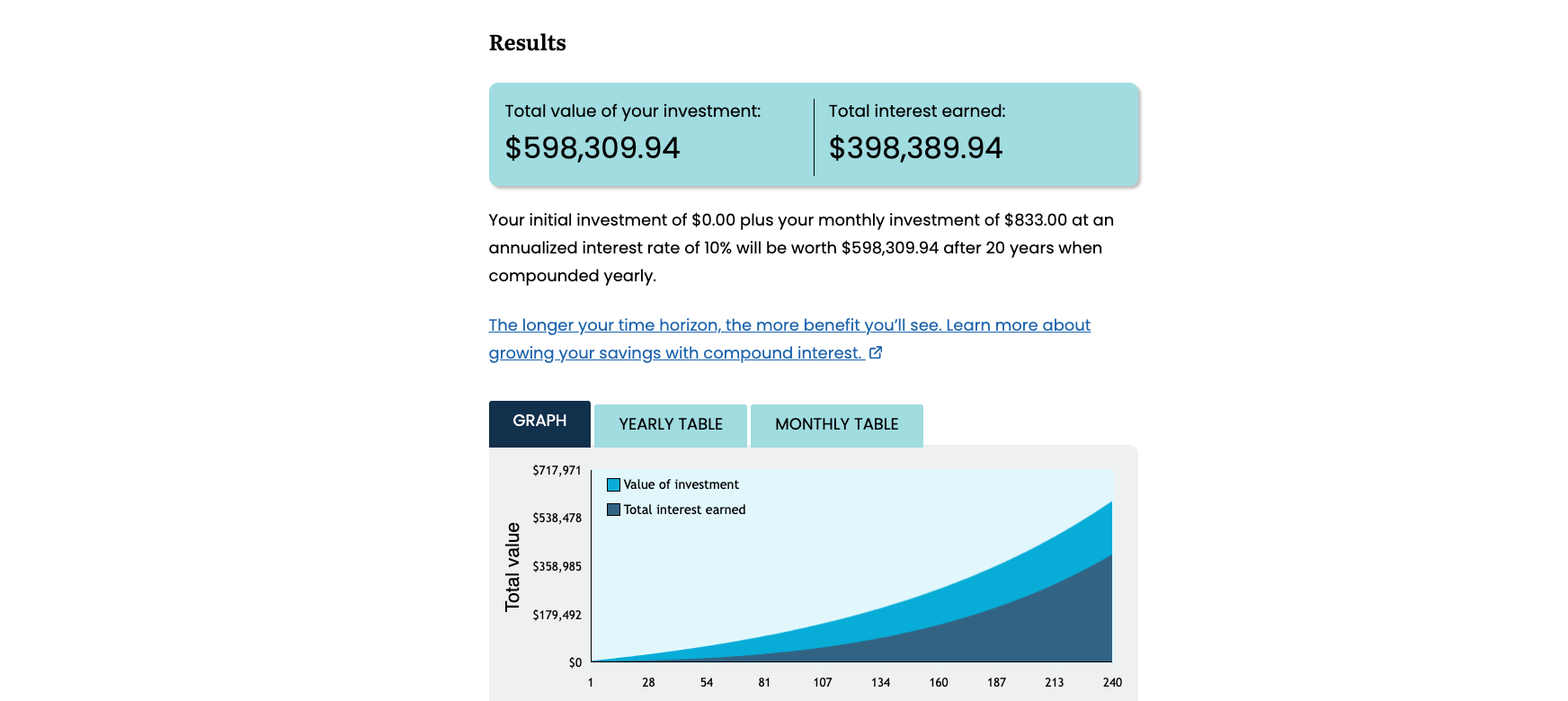
10,000 a year is 27.40 a day. That’s $833 a month.
If you to put that into a S&P 500 or Total US Stock market ETF which usually gives a 10% return for 20 years, you would have 598,309.84
And the crazy part is that $398,389.94 of it is interest.
What I’ve Learned From Looking At This
I have already in many ways making sure I didn’t put all my money into the purchase of my home.
Before looking at these numbers, and studying the F.I.R.E. movement, the individuals that have achieved Financial Indepedance, have put a stong emphasis on investing and staying away from debt.
But from looking at the top 20% of Canadians, there is significant percentage of their net worth directed to financial assets.
And making sure they their real estate assets don’t superseded there financial ones.
A few years ago, I wasn't thinking about asset ownership the way I am today. But over time, I started understanding the importance of investing and controlling lifestyle expenses.
I sold my condo, invested money into the market, and continued driving an older vehicle rather than taking on a new car payment.
I'm not financially independent yet.
I still have to work, and increasing my income is one of my biggest challenges.
But I've started building a foundation that I hope will give me more freedom in the future.